#1: Hanlon's Razor or Why You Should Forestall Assigning Intent to Other's Actions
Never attribute to malice that which is adequately explained by stupidity

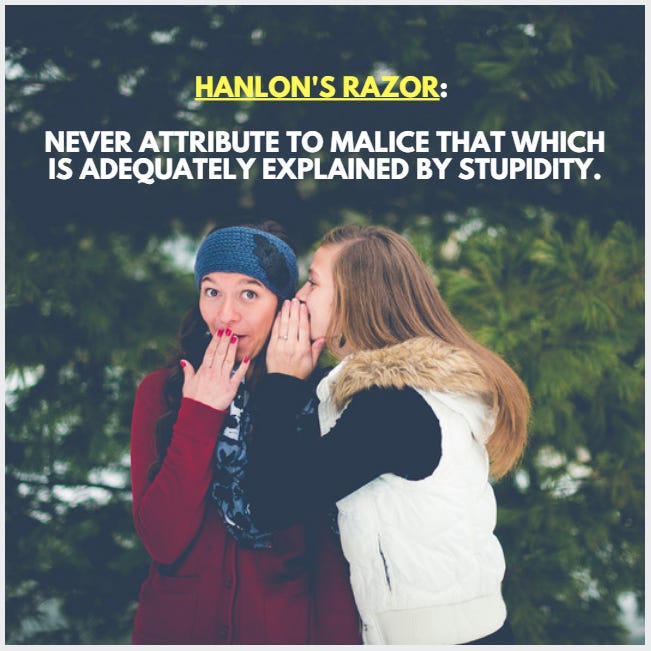
Here's a simple yet groundbreaking idea:
Not everyone is out to get you 😲
Things go wrong all the time in our busy lives. And every time we are at the receiving end of a setback, it is a natural tendency of the human mind to assume malice in people's intent.

A teammate failed to deliver on your project in time? They must be trying to derail your career and beat you to a promotion.
Your house help drops and breaks an expensive plate? They must be trying to annoy you and waste your time.
WiFi in a coffee shop not working? The staff must be lying about having it to lure you in and sample their crappy espresso.
But the simple fact is that these explanations which we tend to jump to are rarely true. Maybe your teammate thought today was Tuesday, not Wednesday.
Maybe your house help had wet hands from doing the dishes.
Maybe the WiFi router was just broken.
When wronged, it is often quite hard to detach from our emotional perspectives and look at the situation objectively. Our egos make us assume that the fault lies within some great conspiracy against us.
This is where Hanlon's Razor comes in handy.
The phrase ‘Hanlon’s razor’ was coined by Robert J. Hanlon, but it has been voiced by many people throughout history, as far back as 1774.
It is a simple heuristic tool for rapid decision-making and intelligent cognition and can be best summarized as such:
“Never attribute to malice that which can be adequately explained by neglect or incompetence.”
The German general Kurt von Hammerstein-Equord used Hanlon’s razor to assess his men, saying:
I divide my officers into four groups. There are clever, diligent, stupid, and lazy officers. Usually two characteristics are combined. Some are clever and diligent – their place is the General Staff. The next lot are stupid and lazy – they make up 90 percent of every army and are suited to routine duties. Anyone who is both clever and lazy is qualified for the highest leadership duties, because he possesses the intellectual clarity and the composure necessary for difficult decisions. One must beware of anyone who is stupid and diligent – he must not be entrusted with any responsibility because he will always cause only mischief.
Applying Hanlon’s razor in our day-to-day lives, allows us to better develop relationships, become less judgmental, and improve rationality. Hanlon’s razor allows us to give people the benefit of the doubt and have more empathy towards them.
In fact, one of the most valuable uses of Hanlon’s razor is in the realm of relationships and daily communication. It is common for people to hurt their relationships by believing other people are intentionally trying to cause problems for them, or behaving in a way intended to be annoying. In most cases, these situations are the result of inability or accidental mistakes.
Douglas Hubbard expanded upon the idea in Failure of Risk Management: Why it’s Broken and How to Fix it:
I would add a clumsier but more accurate corollary to this: “Never attribute to malice or stupidity that which can be explained by moderately rational individuals following incentives in a complex system of interactions.” People behaving with no central coordination and acting in their own best interest can still create results that appear to some to be clear proof of conspiracy or a plague of ignorance.
A short-cut to regulating our often too strong reactions to inadvertent events is to conscientiously reframe the perpetrator as a toddler knocking over a vase.

To make the best use of Hanlon’s razor, we must be sure to put it in context, taking into account logic, experience, and the empirical evidence at hand. Make it a part of your Mental Model network, but do not tip over to being blind towards behaviour which is clearly (or repeatedly) intended to be harmful.